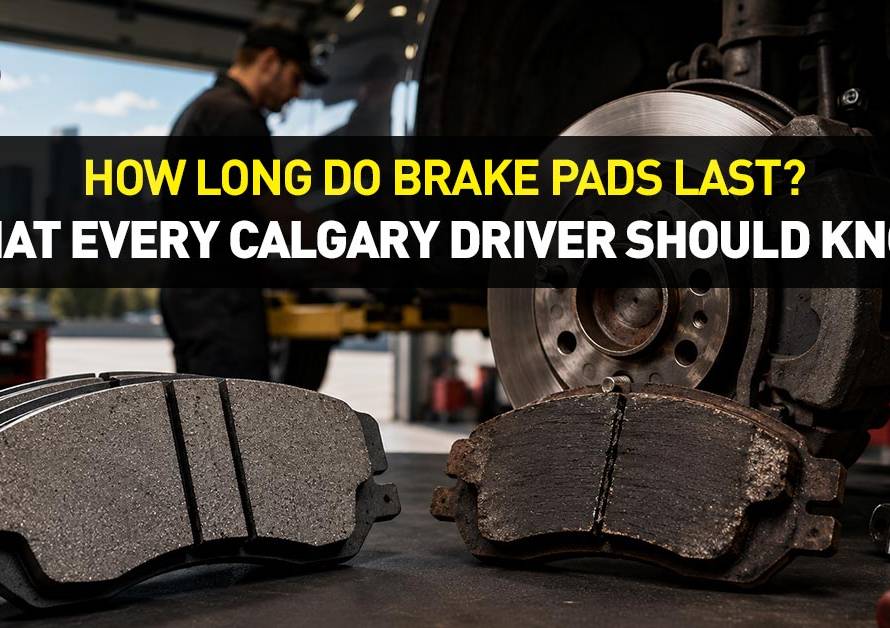
If you drive in Calgary, your brake rotors are working harder than you might think. Brake rotors in Calgary face a uniquely punishing combination of extreme cold, road salt, freeze-thaw cycles, stop-and-go traffic, and pothole-riddled roads. All of this accelerates wear far beyond what most manufacturers predict. So, how long do brake rotors last here – and how do you protect your investment?
This guide answers that question in full. Whether you’re shopping for drilled brake rotors, comparing front brake rotors to rear, or just want to know the brake rotor replacement cost in Calgary, you’ll find everything you need below.
What Are Brake Rotors and Why Do They Matter?
Brake rotors (also called brake discs) are the circular metal discs attached to each wheel hub. When you press the brake pedal, the brake pads clamp against these discs, creating friction that slows and stops your vehicle.
Every time you brake, the rotors absorb enormous heat. They also act as the foundation of your entire braking system. Without properly functioning rotors, even new brake pads cannot stop your vehicle safely or efficiently.
This makes regular brake rotor inspection one of the most important parts of vehicle maintenance – especially in Calgary.
How Long Do Brake Rotors Last in Calgary?
Under ideal conditions, most brake rotors last between 50,000 and 80,000 kilometers. However, brake rotors in Calgary often fall short of that range. Many drivers find their rotors need attention between 40,000 and 60,000 km – sometimes sooner.
Why the difference? Calgary’s specific driving environment creates a perfect storm of conditions that accelerate rotor wear. Road salt, extreme temperature swings, heavy stop-and-go traffic on routes like Deer-foot Trail and McLeod Trail, and spring pothole season all take a toll.
For context, here is how rotor lifespan varies by driver type in a Calgary context:
A light sedan driver who commutes smoothly on Stone Trail may get close to 70,000 km out of a set. A truck or SUV driver who tows, hauls loads, and brakes hard in heavy traffic on Crow child Trail may see rotors worn down well before 40,000 km. The good news is that most of these factors are within your control.
How Calgary’s Climate Shortens Brake Rotor Life
Calgary’s climate is one of the harshest on brake components of any major Canadian city. Here is why.
Road Salt and Corrosion
From October through April, Calgary roads are treated with granular salt and liquid brine solutions containing calcium chloride and magnesium chloride. These chemicals are effective at melting ice, but they are also highly corrosive to metal. Brake rotors made from standard cast iron are especially vulnerable.
Salt accelerates the formation of rust on rotor surfaces. While a thin layer of surface rust after overnight parking is normal, repeated and deep corrosion eats into the rotor’s braking surface over time. This reduces rotor thickness, creates uneven surfaces, and shortens the rotor’s usable life significantly.
Extreme Temperature Swings
Calgary is famous for its Chinook weather events. Temperatures can swing 20 to 30 degrees Celsius in a single day. This rapid thermal cycling causes rotors to expand and contract repeatedly. Over time, this can warp the rotor surface and lead to uneven pad contact and braking vibrations.
Overnight temperatures in Calgary can drop below –20°C, while daytime driving can heat rotors to well above 200°C. That is a dramatic range, and it stresses rotor metal in a way that moderate climates simply do not.
Winter Moisture and Frozen Components
Snow and slush contact rotors constantly during winter driving. This moisture can cause surface rust to form overnight. It can also freeze around brake components like caliper guide pins, causing them to seize. A seized caliper pin keeps the brake pad pressed against the rotor at all times, which generates abnormal heat and dramatically accelerates rotor wear.
Therefore, a Calgary winter does not just add miles to your rotors – it actively degrades them chemically and mechanically at the same time.
Quick Guide: How Often Should You Replace Brake Pads?
Pothole Season: Calgary’s Hidden Brake Killer
Spring in Calgary brings pothole season, and it is brutal. The freeze-thaw cycle that defines Alberta winters opens up deep cracks in pavement across high-traffic corridors. Macleod Trail, Deerfoot Trail, Crowchild Trail, Memorial Drive, and Glenmore Trail are among the worst-affected routes each spring.
Hitting a pothole at speed does more than jar your suspension. It transfers a sharp, sudden impact through the wheel hub directly to your brake rotor. Repeated impacts like this can cause micro-cracks in rotor surfaces, contribute to warping, and knock wheel alignment out of spec.
Misalignment from pothole damage is an indirect brake killer. When a vehicle pulls to one side, uneven pressure builds up on the rotor surface, causing accelerated and uneven wear over time. If you hit a significant pothole in Calgary, it is always worth having your braking system inspected alongside your tires and suspension.
How Your Driving Habits Affect Rotor Lifespan
Calgary’s roads are demanding, but your driving style also plays a major role in how long your brake rotors last.
Hard, late braking generates significantly more heat than smooth, progressive stops. That extra heat removes more rotor material with every stop and accelerates the thermal cycling that weakens rotor structure over time. A driver who brakes gently and leaves adequate following distance will consistently get more kilometres out of a set of rotors than one who brakes late and hard.
Stop-and-go traffic on Calgary’s busiest routes – downtown, Deerfoot Trail, and major shopping corridors near Chinook Centre and CrossIron Mills – creates frequent partial braking events that add up quickly.
Towing and heavy loads also matter. Physics is straightforward here: a heavier vehicle transfers more kinetic energy into the braking system during every stop. A pickup truck hauling a trailer puts substantially more stress on its rotors than the same truck driven empty. Anticipating stops, maintaining safe following distances, and using engine braking on downhill sections all help extend rotor life meaningfully.
Types of Brake Rotors in Calgary: Which One Should You Choose?
Choosing the right rotor type matters in Calgary’s conditions. Here is a breakdown of your main options.
Standard Blank Rotors
Standard blank (smooth) rotors are the most common and cost-effective choice for everyday Calgary commuters. They have the most braking surface material and generally last the longest under normal daily-driving conditions. For a family sedan or small SUV used primarily for urban commuting, blank rotors are a practical and durable choice.
Drilled Brake Rotors
Drilled brake rotors feature holes machined through the braking surface. They improve wet-weather performance by channelling water away from the pad contact area – a benefit in Calgary’s rain and slush seasons. However, the holes create stress points that can lead to cracking under extreme or aggressive use. For daily drivers in Calgary, drilled rotors offer a modest performance improvement but may not last quite as long as solid blank rotors.
Slotted Brake Rotors
Slotted rotors have machined grooves cut into the braking surface. These grooves sweep away gas, dust, and debris from between the pad and rotor. Unlike drilled rotors, slots do not create the same stress concentration points, so they are more resistant to cracking. Slotted rotors are popular among Calgary drivers who tow, haul, or drive SUVs and trucks. The tradeoff is slightly faster brake pad wear.
Drilled and Slotted Brake Rotors
Drilled and slotted brake rotors combine both features. They offer excellent heat dissipation and debris clearing, making them a popular performance upgrade. However, they also combine the tradeoffs of both designs. For Calgary drivers doing aggressive driving, towing, or who want a performance look without going to track-only options, drilled and slotted rotors can be a good fit. They typically cost 50 to 150 percent more than standard rotors.
Ceramic Brake Rotors
Ceramic brake rotors are at the premium end of the spectrum. They are extremely resistant to heat and corrosion, which makes them well-suited in theory for Calgary’s harsh conditions. However, they are typically found on high-performance or luxury vehicles and come at a significantly higher cost. For most everyday Calgary drivers, ceramic rotors represent a large investment with returns that may not justify the price over standard quality coated rotors.
For Calgary’s winter conditions specifically, coated rotors – standard rotors with a protective anti-corrosion coating – offer an excellent balance. They resist the salt-induced rust that eats plain cast iron rotors and can meaningfully extend rotor life through a full Calgary winter.
Front Brake Rotors vs. Rear Brake Rotors: What Wears Faster?
Front brake rotors almost always wear faster than rear ones. This is because the front axle carries more of the vehicle’s braking load. When you press the brake pedal, the weight transfers forward, putting more pressure on the front brakes.
As a result, front brake rotors typically need replacement more often than rear rotors. It is not uncommon for a Calgary driver to replace front rotors twice before the rear rotors require attention. This is why checking brake rotors and pads per axle – front and rear separately – is the correct approach. Replacing both axles at the same time is not always necessary, but you should always replace rotors in pairs on the same axle to ensure even, balanced braking.
Warning Signs That Your Brake Rotors Need Replacing
Catching rotor wear early saves money and keeps you safe on Calgary roads. Watch for these signs.
Squealing or grinding sounds when you apply the brakes are often the first signal that brake pads have worn down to the point where metal is contacting the rotor. Grinding specifically suggests metal-on-metal contact and means the rotor surface may already be damaged.
Useful Guide: Why Are My Brakes Squeaking? Causes and Fixes
Vibration or pulsation through the brake pedal or steering wheel when braking indicates warped or uneven rotors. This is common in Calgary after repeated temperature extremes.
Longer stopping distances mean the braking system is no longer performing as it should. On icy Calgary roads, where stopping distances are already extended, this is especially dangerous.
Visible scoring or deep grooves on the rotor surface indicate that the brake pads have worn past safe limits and damaged the rotor face.
Blue discoloration on the rotor surface signals heat damage and metallurgical changes in the rotor material. This rotor should be inspected immediately.
Rust ridges around the outer rotor edge that do not clear after a few stops suggest deeper corrosion that compromises the rotor’s integrity.
If you notice any of these signs, book a brake inspection right away. Do not delay – brake failure on a Calgary road in winter conditions can be life-threatening.
Also Read: How to Solve the Problem of Warped Brake Rotors
Brake Rotor Replacement Cost in Calgary
Understanding the brake rotor replacement cost in Calgary helps you plan and budget without surprises.
For most Calgary drivers, the combined cost of brake rotor and pad replacement is typically between $400 and $800 per axle. This range accounts for parts and labour together.
If you are replacing rotors alone (without pads), you can expect roughly $250 to $500 per axle at an independent shop. Labour rates in Calgary generally run between $120 and $160 per hour, and a standard front axle rotor replacement takes approximately one to two hours.
Here is a general breakdown to guide your expectations:
For a compact car or sedan at an independent shop, a front axle brake service with standard rotors and ceramic pads often falls in the $350 to $500 range. Mid-size SUVs with drilled or slotted rotors typically run $450 to $650 per axle. Larger trucks, luxury vehicles, or vehicles requiring specialty parts can exceed $800 to $1,000 per axle, particularly at dealerships.
Choosing an independent shop like Urban Lube over a dealership can save you considerably on labour costs without any sacrifice in quality when reputable brake components are used. Also, replacing brake rotors and pads together in one service visit is more cost-efficient than scheduling them separately.
Cheap brake rotors may seem appealing, but discount brake rotors that sacrifice quality can wear out much faster, cost more to replace over time, and compromise your safety. Investing in quality parts – especially corrosion-resistant coated rotors suited to Calgary conditions – pays off in the long run.
Tips to Make Your Brake Rotors Last Longer in Calgary
You can significantly extend the life of your brake rotors in Calgary by following a few practical habits.
Wash your undercarriage frequently during winter. Road salt buildup on brake components accelerates corrosion dramatically. Regular undercarriage washes – especially after snowstorms – remove salt and brine before they can cause damage.
Brake smoothly and progressively. Anticipate stops early and apply brakes gradually. This generates less heat per stop and reduces thermal stress on your rotors.
Get your brakes inspected every 20,000 to 25,000 km. Early detection of pad wear prevents metal-on-metal contact that damages rotors and turns a simple pad replacement into a costly full brake service.
Choose the right rotor type for your driving. Calgary drivers who tow or drive larger vehicles benefit from slotted or coated rotors. Everyday commuters get excellent value from quality coated blank rotors.
Pair new rotors with new brake pads. Installing new pads on worn, uneven rotors causes vibration and accelerated wear on both components. Always replace them together.
Avoid parking in a heated garage immediately after winter driving. While it seems counter-intuitive, salt and brine are most corrosive at slightly above-freezing temperatures. Parking in a warm garage after driving on salted roads accelerates corrosion on brake components.
Why Choose Urban Lube for Brake Maintenance Near You in Calgary?
At Urban Lube, we understand exactly what Calgary driving does to your vehicle’s braking system. Our experienced technicians perform thorough brake inspections and honest, transparent service – you only pay for what your vehicle actually needs.
We use quality brake components suited to Calgary’s demanding conditions and offer competitive pricing on brake rotors and pads replacement across all vehicle types, from daily commuter sedans to trucks and SUVs.
Whether you need a routine brake check, front brake rotor replacement, or a full brake system service, Urban Lube is your trusted brake maintenance partner in Calgary.
Book your appointment today and drive with confidence – all year long.